
线程与线程池
线程与线程池

一. 线程
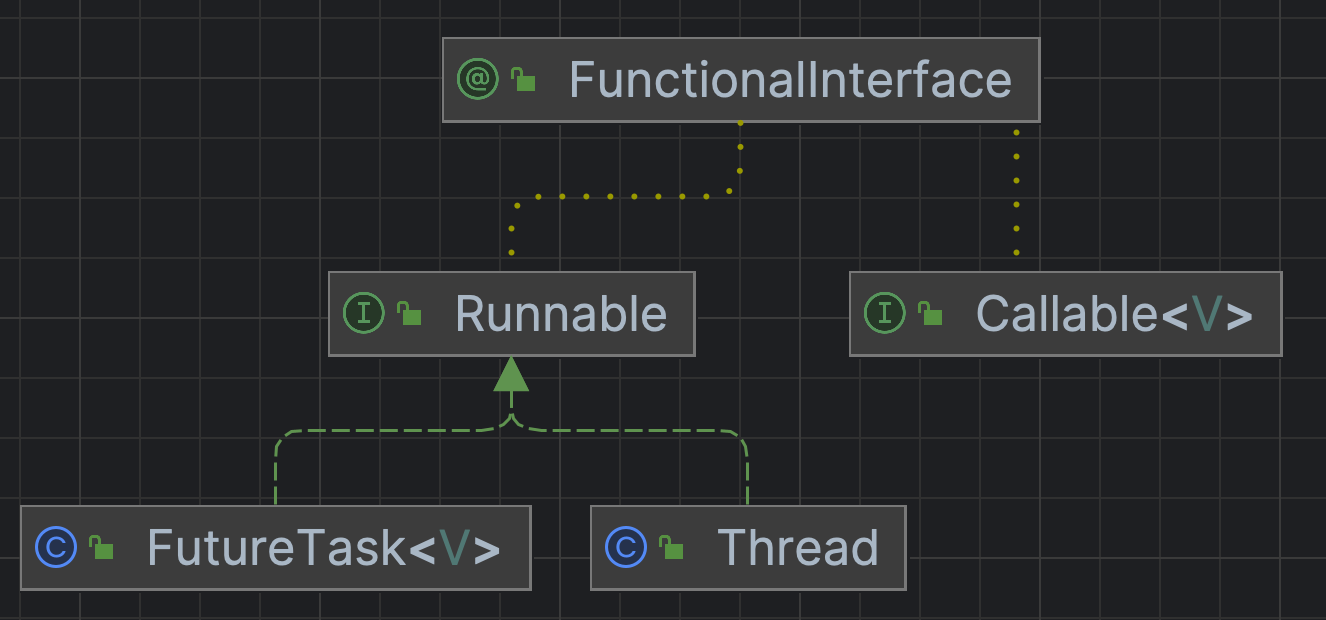
1. 线程的创建和启动
import java.util.concurrent.Callable;
import java.util.concurrent.ExecutorService;
import java.util.concurrent.Executors;
import java.util.concurrent.FutureTask;

public class CreateThread {

    public static void main(String[] args) throws Exception {
        // 1. 继承Thread
        new MyThread().start(); // From Thread:Thread-0
        // 2. 实现Runnable
        new Thread(new MyRunnable()).start(); // From Runnable:Thread-1
        // 3. 实现Callable,使用FutureTask ,有返回值
        FutureTask<String> futureTask = new FutureTask<>(new MyCallable());
        new Thread(futureTask).start();
        System.out.println(futureTask.get()); // From Callable:Thread-2
        // 4. 使用线程池ThreadPoolExecutor
        final ExecutorService threadPool = Executors.newSingleThreadExecutor();
        threadPool.execute(() -> System.out.println("From ThreadPool:" + Thread.currentThread().getName())); // From ThreadPool:pool-1-thread-1
        threadPool.shutdown();
    }

    static class MyThread extends Thread {
        @Override
        public void run() {
            System.out.println("From Thread:" + Thread.currentThread().getName());
        }
    }

    static class MyRunnable implements Runnable {
        @Override
        public void run() {
            System.out.println("From Runnable:" + Thread.currentThread().getName());
        }
    }

    static class MyCallable implements Callable<String> {
        @Override
        public String call() throws Exception {
            return "From Callable:" + Thread.currentThread().getName();
        }
    }
}
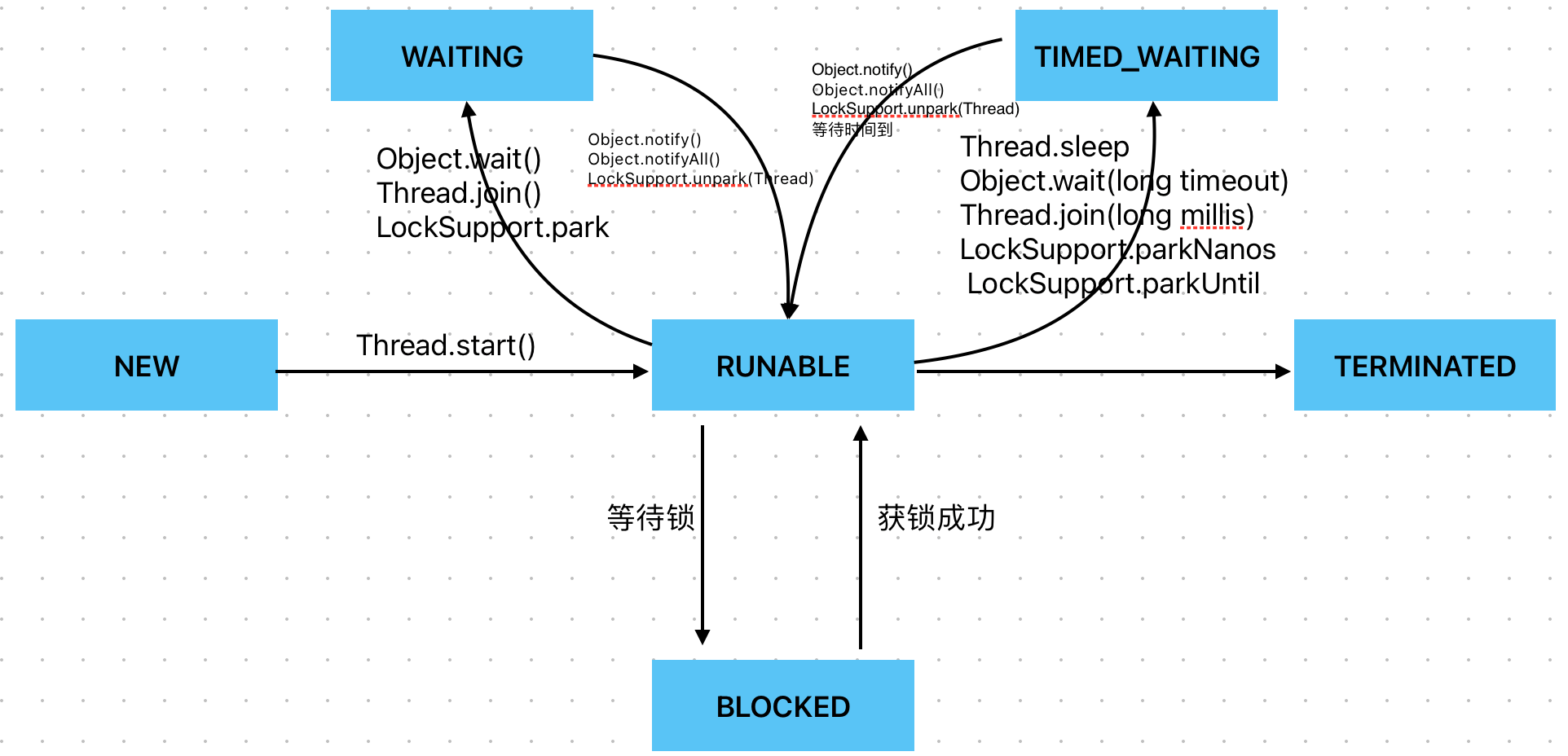
2. Java中线程的状态
参考: Thread.State
NEW新建,还没有启动
RUNNABLE就绪,在JVM中执行,但是可能需要等待操作系统的调度
BLOCKED阻塞(等待监视器锁(monitor lock)阻塞),等待进入同步块或方法,或者在调用
Object.wait()后等待重入同步块或方法WAITING等待,处于等待的线程正在等待另一个线程的操作,例如wait等待notify/notifyAll,调用如下方法线程将进入等待状态:
Object.wait()不加超时Thread.join()不加超时LockSupport.park
TIMED_WAITING超时等待,调用如下方法将进入超时等待状态:
Thread.sleepObject.wait(long timeout)Thread.join(long millis)LockSupport.parkNanosLockSupport.parkUntil
TERMINATED终止,线程已完成执行
3. 线程的中断
线程不能被直接终止,可以通过设置一个中断标志位,通知被中断的线程自行处理(如抛出异常,逻辑结束等)
Thread.interrupt()设置中断标志位为true,并不会真正中断线程Thread.interrupted()判断线程是否被中断,注意调用两次时,第二次会返回false(会清除标志位)public static boolean interrupted() { return currentThread().isInterrupted(true); }Thread.isInterrupted()判断线程是否被中断public boolean isInterrupted() { return isInterrupted(false); }
正确中断线程示例(逻辑结束)
    public static void main(String[] args) throws InterruptedException {
        Thread thread = new Thread() {
            @Override
            public void run() {
                System.out.println("start");
                while (!isInterrupted()) {
                    System.out.println("线程没有被中断");
                }
                System.out.println("线程被中断了...");
            }
        };
        thread.start();

        Thread.sleep(1_000);

        thread.interrupt();

        System.out.println(thread.getName() + ":" + thread.isInterrupted() + ":" + thread.getState());
    }
4. 线程间的通信
4.1 等待/通知机制
synchronized + wait + notify/notifyAll
public class ThreadCommunication {

    private static Object lock = new Object();

    public static void main(String[] args) throws InterruptedException {
        ThreadA threadA = new ThreadA();
        ThreadB threadB = new ThreadB();

        threadA.start();
        Thread.sleep(2_000);
        threadB.start();
        /*
            A先执行,遇到wait等待,2秒后B执行,遇到notify唤醒A,B和A结束
            Thread A start
            Thread B start
            Thread B end
            Thread A end
         */
    }

    static class ThreadA extends Thread {
        @Override
        public void run() {
            synchronized (lock) {
                System.out.println("Thread A start");
                try {
                    lock.wait();
                } catch (InterruptedException e) {
                    throw new RuntimeException(e);
                }
                System.out.println("Thread A end");
            }
        }
    }

    static class ThreadB extends Thread {
        @Override
        public void run() {
            synchronized (lock) {
                System.out.println("Thread B start");
                lock.notifyAll();
                System.out.println("Thread B end");
            }
        }
    }
}
4.2 join
Thread#join(long),使当前线程进入"等待"状态,等join的线程完成后,再继续执行当前线程
join方法通过Object.wait()实现
public class ThreadCommunication {

    public static void main(String[] args) throws InterruptedException {
        ThreadC threadC = new ThreadC();
        threadC.start();
        threadC.join();  // 当threadC完成后才能继续执行

        // do something
    }

    static class ThreadC extends Thread {
        @Override
        public void run() {
            System.out.println("Thread C start,等待3秒");
            try {
                Thread.sleep(3_000);
            } catch (InterruptedException e) {
                throw new RuntimeException(e);
            }
            System.out.println("Thread C end");
        }
    }
}
4.3 ThreadLocal和InheritableThreadLocal
ThreadLocal是一个本地线程副本变量工具类
InheritableThreadLocal继承自ThreadLocal,不仅当前线程可以存取副本值,它的子线程也可以存取这个副本值
4.4 信号量(volatile)
volatile保证了可见性和有序性,线程修改一个变量时,其他线程立刻可见
4.5 锁 、通信工具类
锁如Lock,通信工具类如CountDownLatch
5. 线程的常见方法
currentThread返回当前线程yield放弃当前的CPU资源,将它让给其他的任务去占用CPU执行时间。但放弃的时间不确定,有可能刚刚放弃,马上又获得CPU时间片sleep在指定时间内让当前正在执行的线程休眠Thread.sleep 和 Object.wait的区别
- sleep释放CPU资源但是不释放锁,wait都释放
- sleep必须指定时间,wait可不指定
- sleep可以在任意位置,wait只能方法同步块或同步方法中
interrupt线程中断标志位
join使当前线程进入"等待"状态,等join的线程完成后,再继续执行当前线程
setDaemon设置为后台线程
二. 线程池
1. 为什么使用线程池
如果为每一个任务都分配一个线程会产生一些问题,尤其是在需要创建大量线程的场景,主要如下:
线程生命周期的开销非常高
线程的创建和销毁需要时间,需要JVM和操作系统辅助
资源消耗
活跃的线程后消耗系统资源,尤其是内存。如果可运行的线程数量多于可用处理器的数量,那么有些线程将闲置,大量闲置的线程还会占用许多内存,给GC带来压力,而且大量线程在竞争CPU资源时还将产生其他的性能开销
稳定性
可创建线程的数量会受到操作系统、JVM参数等的限制,超过限制会引发异常不稳定
那么在使用线程池时会有如下的优势:
- 可以复用已创建的线程
- 可以控制并发的数量
- 可以对线程做统一管理(分配、调优、监控等)
2. 线程池的使用
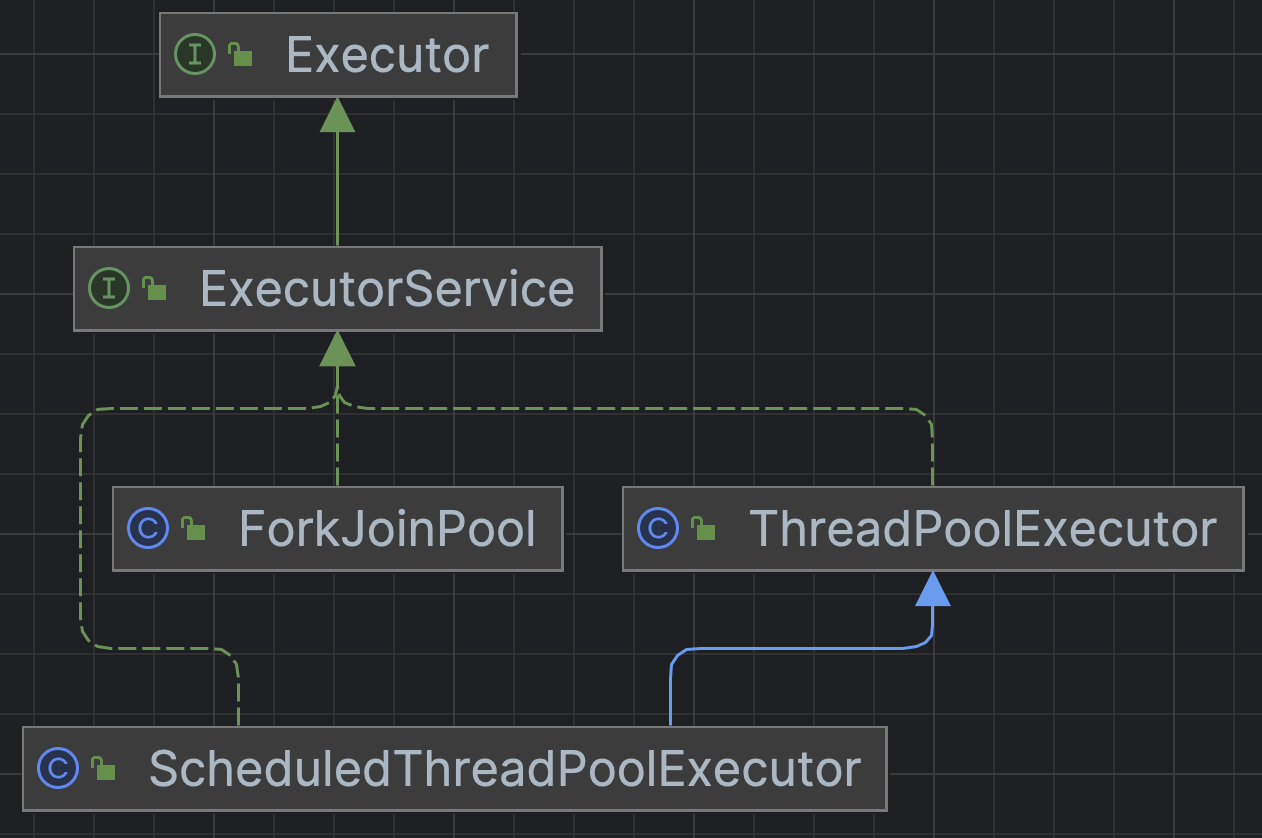
2.1 创建线程池
可以通过ThreadPoolExecutor来创建线程池(或者通过其他方式,如Spring中的ThreadPoolTaskExecutor),例如
ThreadPoolExecutor threadPool = = new ThreadPoolExecutor(10,20,60, TimeUnit.SECONDS,new ArrayBlockingQueue<>(10));
2.2 向线程池提交任务
提交不需要返回值的任务
threadPool.execute(() -> System.out.println(Thread.currentThread().getName()));
// print: pool-1-thread-1
提交需要返回值的任务
Future<String> future = threadPool.submit(() -> Thread.currentThread().getName());
System.out.println(future.get());
// print: pool-1-thread-1
2.3 关闭线程池
threadPool.shutdown()将线程池的状态设置为
SHUTDOWN,然后中断所有没有正在执行任务的线程public void shutdown() { final ReentrantLock mainLock = this.mainLock; mainLock.lock(); try { checkShutdownAccess(); advanceRunState(SHUTDOWN); interruptIdleWorkers(); onShutdown(); // hook for ScheduledThreadPoolExecutor } finally { mainLock.unlock(); } tryTerminate(); }threadPool.shutdownNow()将线程池的状态设置为
STOP,然后尝试停止所有的正在执行或者暂停任务的线程,并返回等待执行任务的列表public List<Runnable> shutdownNow() { List<Runnable> tasks; final ReentrantLock mainLock = this.mainLock; mainLock.lock(); try { checkShutdownAccess(); advanceRunState(STOP); interruptWorkers(); tasks = drainQueue(); } finally { mainLock.unlock(); } tryTerminate(); return tasks; }
shutdown和shutdownNow的异同:
- 都是通过遍历线程池中的线程,然后调用
t.interrupt()来中断线程; - 两个方法都会使
isShutdown返回true; - 当所有的任务都已关闭后,才表示线程池关闭成功,这时
isTerminated方法会返回true; - 通常用
shutdown来关闭线程池,如果任务不一定要执行完可以调用shutdownNow
如果在工程中,线程池尽量不要随着请求创建和关闭(频繁的创建关闭线程池是一个不小的开销),可以随着项目创建和关闭。特殊场景下,如每天定时跑一次任务,可以尝试由方法管理生命周期。
《Java并发编程实战》(7.2.4 示例:只执行一次的服务 ): 某个方法需要处理一批任务并且当所有任务都处理完成后才返回,可以通过一个私有的Executor来简化服务的生命周期管理,其中该Executor的生命周期是由这个方法来控制
3. 线程池的工作原理
3.1 线程池的构造参数
ThreadPoolExecutor的构造方法最长的参数有7个
public ThreadPoolExecutor(int corePoolSize,
                          int maximumPoolSize,
                          long keepAliveTime,
                          TimeUnit unit,
                          BlockingQueue<Runnable> workQueue,
                          ThreadFactory threadFactory,
                          RejectedExecutionHandler handler) {...}
3.1.1 int corePoolSize 核心线程数
线程池中分为核心线程和非核心线程,通过addWorker(Runnable firstTask, boolean core)的第二个参数区分。
核心线程默认情况会一直存在于线程池中(即使什么都不干),非核心线程如果长时间闲置,就会被销毁。
但是当allowCoreThreadTimeOut为true时,核心线程也会长时间闲置被销毁
corePoolSize
Core pool size is the minimum number of workers to keep alive (and not allow to time out etc) unless allowCoreThreadTimeOut is set, in which case the minimum is zero.
Since the worker count is actually stored in COUNT_BITS bits, the effective limit is corePoolSize & COUNT_MASK.
3.1.2 int maximumPoolSize 最大线程数
最先线程数 = 核心线程数 + 非核心线程数
maximumPoolSize
Maximum pool size.
Since the worker count is actually stored in COUNT_BITS bits, the effective limit is maximumPoolSize & COUNT_MASK.
3.1.3 long keepAliveTime 非核心线程闲置超时时长
存活时间,非核心线程如果处于闲置状态超过该值就会被销毁。
如果设置allowCoreThreadTimeOut(true),则也会作用于核心线程
  Runnable r = timed
  	? workQueue.poll(keepAliveTime, TimeUnit.NANOSECONDS)
  	: workQueue.take();
keepAliveTime
Timeout in nanoseconds for idle threads waiting for work.
Threads use this timeout when there are more than corePoolSize present or if allowCoreThreadTimeOut. Otherwise they wait forever for new work.
3.1.4 TimeUnit unit 时间单位
keepAliveTime的单位
this.keepAliveTime = unit.toNanos(keepAliveTime);
3.1.5 BlockingQueue<Runnable> workQueue 工作队列
工作队列(阻塞队列),保存等待执行任务的队列
常用的阻塞队列有 无界队列、有界队列和同步移交
LinkedBlockingQueue链表为基础的阻塞队列,默认大小是Integer.MAX_VALUE,也可以指定大小ArrayBlockingQueue数组为基础的阻塞队列,需要指定队列的大小SynchronousQueue同步队列,内部容量为0,每个put操作必须等待一个take操作,反之亦然DelayQueue延迟队列,队列中的元素只有当其指定的延迟时间到了才能从队列中获取该元素
workQueue
The queue used for holding tasks and handing off to worker threads.
We do not require that workQueue.poll() returning null necessarily means that workQueue.isEmpty(), so rely solely on isEmpty to see if the queue is empty (which we must do for example when deciding whether to transition from SHUTDOWN to TIDYING).
This accommodates special-purpose queues such as DelayQueues for which poll() is allowed to return null even if it may later return non-null when delays expire.
3.1.6 ThreadFactory threadFactory 线程工厂
创建线程的工厂,统一在创建线程时设置参数,如守护线程、优先级等,不指定时新建一个默认的线程工厂
        Worker(Runnable firstTask) {
            setState(-1); // inhibit interrupts until runWorker
            this.firstTask = firstTask;
            this.thread = getThreadFactory().newThread(this);
        }
默认线程工厂
    /**
     * The default thread factory.
     */
    private static class DefaultThreadFactory implements ThreadFactory {
        private static final AtomicInteger poolNumber = new AtomicInteger(1);
        private final ThreadGroup group;
        private final AtomicInteger threadNumber = new AtomicInteger(1);
        private final String namePrefix;

        DefaultThreadFactory() {
            SecurityManager s = System.getSecurityManager();
            group = (s != null) ? s.getThreadGroup() :
                                  Thread.currentThread().getThreadGroup();
            namePrefix = "pool-" +
                          poolNumber.getAndIncrement() +
                         "-thread-";
        }

        public Thread newThread(Runnable r) {
            Thread t = new Thread(group, r,
                                  namePrefix + threadNumber.getAndIncrement(),
                                  0);
            if (t.isDaemon())
                t.setDaemon(false);
            if (t.getPriority() != Thread.NORM_PRIORITY)
                t.setPriority(Thread.NORM_PRIORITY);
            return t;
        }
    }
threadFactory
Factory for new threads.
All threads are created using this factory (via method addWorker). All callers must be prepared for addWorker to fail, which may reflect a system or user's policy limiting the number of threads. Even though it is not treated as an error, failure to create threads may result in new tasks being rejected or existing ones remaining stuck in the queue. We go further and preserve pool invariants even in the face of errors such as OutOfMemoryError, that might be thrown while trying to create threads. Such errors are rather common due to the need to allocate a native stack in Thread.start, and users will want to perform clean pool shutdown to clean up. There will likely be enough memory available for the cleanup code to complete without encountering yet another OutOfMemoryError.
3.1.7 RejectedExecutionHandler handler 拒绝策略
拒绝处理策略,线程数量大于最大线程就会采用拒绝策略,在线程池shutdown时再新来任务也会执行,预定义四种拒绝策略,
也可以通过实现RejectedExecutionHandler来实现自定义拒绝策略,如拒绝的任务可以存入日志等
AbortPolicy 默认,丢弃任务并抛出RejectedExecutionException异常
    /**
     * A handler for rejected tasks that throws a
     * {@link RejectedExecutionException}.
     *
     * This is the default handler for {@link ThreadPoolExecutor} and
     * {@link ScheduledThreadPoolExecutor}.
     */
    public static class AbortPolicy implements RejectedExecutionHandler {
        /**
         * Creates an {@code AbortPolicy}.
         */
        public AbortPolicy() { }

        /**
         * Always throws RejectedExecutionException.
         *
         * @param r the runnable task requested to be executed
         * @param e the executor attempting to execute this task
         * @throws RejectedExecutionException always
         */
        public void rejectedExecution(Runnable r, ThreadPoolExecutor e) {
            throw new RejectedExecutionException("Task " + r.toString() +
                                                 " rejected from " +
                                                 e.toString());
        }
    }
DiscardPolicy丢弃新来的任务,但是不抛出异常
    /**
     * A handler for rejected tasks that silently discards the
     * rejected task.
     */
    public static class DiscardPolicy implements RejectedExecutionHandler {
        /**
         * Creates a {@code DiscardPolicy}.
         */
        public DiscardPolicy() { }

        /**
         * Does nothing, which has the effect of discarding task r.
         *
         * @param r the runnable task requested to be executed
         * @param e the executor attempting to execute this task
         */
        public void rejectedExecution(Runnable r, ThreadPoolExecutor e) {
        }
    }
DiscardOldestPolicy 丢弃队列头部(最旧的)任务,然后重新尝试执行程序,如果再次失败则重复此过程
    /**
     * A handler for rejected tasks that discards the oldest unhandled
     * request and then retries {@code execute}, unless the executor
     * is shut down, in which case the task is discarded.
     */
    public static class DiscardOldestPolicy implements RejectedExecutionHandler {
        /**
         * Creates a {@code DiscardOldestPolicy} for the given executor.
         */
        public DiscardOldestPolicy() { }

        /**
         * Obtains and ignores the next task that the executor
         * would otherwise execute, if one is immediately available,
         * and then retries execution of task r, unless the executor
         * is shut down, in which case task r is instead discarded.
         *
         * @param r the runnable task requested to be executed
         * @param e the executor attempting to execute this task
         */
        public void rejectedExecution(Runnable r, ThreadPoolExecutor e) {
            if (!e.isShutdown()) {
                e.getQueue().poll();
                e.execute(r);
            }
        }
    }
CallerRunsPolicy 由调用线程处理该任务
    /**
     * A handler for rejected tasks that runs the rejected task
     * directly in the calling thread of the {@code execute} method,
     * unless the executor has been shut down, in which case the task
     * is discarded.
     */
    public static class CallerRunsPolicy implements RejectedExecutionHandler {
        /**
         * Creates a {@code CallerRunsPolicy}.
         */
        public CallerRunsPolicy() { }

        /**
         * Executes task r in the caller's thread, unless the executor
         * has been shut down, in which case the task is discarded.
         *
         * @param r the runnable task requested to be executed
         * @param e the executor attempting to execute this task
         */
        public void rejectedExecution(Runnable r, ThreadPoolExecutor e) {
            if (!e.isShutdown()) {
                r.run();
            }
        }
    }
handler
Handler called when saturated or shutdown in execute.
3.2 线程池的状态
    // runState is stored in the high-order bits
    private static final int RUNNING    = -1 << COUNT_BITS;
    private static final int SHUTDOWN   =  0 << COUNT_BITS;
    private static final int STOP       =  1 << COUNT_BITS;
    private static final int TIDYING    =  2 << COUNT_BITS;
    private static final int TERMINATED =  3 << COUNT_BITS;
- RUNNING:线程池当前正在运行,线程池创建后出入RUNNING状态
- SHUTDOWN:调用shutdown()后,线程池即将关闭,不再接收新任务,但会继续处理队列中的任务。
- STOP:调用shutdownNow()后,线程池已经关闭,不再接收新任务,不再处理队列中的任务,并试图中断正在执行的任务。此时poolsize=0,阻塞队列的size=0。
- TIDYING:线程池当前正在关闭,并且已经完成所有的任务,正在进入收尾阶段。
- TERMINATED:执行完terminated()后,线程池已经关闭,所有任务已经终止,并且已经进入收尾阶段
3.2 线程池的工作流程
应用程序将任务通过execute()或submit()方法提交的线程池,如下是execute()方法的流程分析
源码注释 ThreadPoolExecutor#execute
/*
 * Proceed in 3 steps:
 *
 * 1. If fewer than corePoolSize threads are running, try to
 * start a new thread with the given command as its first
 * task.  The call to addWorker atomically checks runState and
 * workerCount, and so prevents false alarms that would add
 * threads when it shouldn't, by returning false.
 *
 * 2. If a task can be successfully queued, then we still need
 * to double-check whether we should have added a thread
 * (because existing ones died since last checking) or that
 * the pool shut down since entry into this method. So we
 * recheck state and if necessary roll back the enqueuing if
 * stopped, or start a new thread if there are none.
 *
 * 3. If we cannot queue task, then we try to add a new
 * thread.  If it fails, we know we are shut down or saturated
 * and so reject the task.
 */
private final AtomicInteger ctl = new AtomicInteger(ctlOf(RUNNING, 0));
The main pool control state, ctl, is an atomic integer packing two conceptual fields workerCount, indicating the effective number of threads runState, indicating whether running, shutting down etc
In order to pack them into one int, we limit workerCount to (2^29)-1 (about 500 million) threads rather than (2^31)-1 (2 billion) otherwise representable. If this is ever an issue in the future, the variable can be changed to be an AtomicLong, and the shift/mask constants below adjusted. But until the need arises, this code is a bit faster and simpler using an int.
The workerCount is the number of workers that have been permitted to start and not permitted to stop. The value may be transiently different from the actual number of live threads, for example when a ThreadFactory fails to create a thread when asked, and when exiting threads are still performing bookkeeping before terminating. The user-visible pool size is reported as the current size of the workers set.
The runState provides the main lifecycle control, taking on values:
RUNNING: Accept new tasks and process queued tasks SHUTDOWN: Don't accept new tasks, but process queued tasks STOP: Don't accept new tasks, don't process queued tasks, and interrupt in-progress tasks TIDYING: All tasks have terminated, workerCount is zero, the thread transitioning to state TIDYING will run the terminated() hook method TERMINATED: terminated() has completed
The numerical order among these values matters, to allow ordered comparisons. The runState monotonically increases over time, but need not hit each state. The transitions are:
RUNNING -> SHUTDOWN On invocation of shutdown() (RUNNING or SHUTDOWN) -> STOP On invocation of shutdownNow() SHUTDOWN -> TIDYING When both queue and pool are empty STOP -> TIDYING When pool is empty TIDYING -> TERMINATED When the terminated() hook method has completed
Threads waiting in awaitTermination() will return when the state reaches TERMINATED.
Detecting the transition from SHUTDOWN to TIDYING is less straightforward than you'd like because the queue may become empty after non-empty and vice versa during SHUTDOWN state, but we can only terminate if, after seeing that it is empty, we see that workerCount is 0 (which sometimes entails a recheck -- see below).

// 翻译一下~
主池控制状态ctl是一个原子整数,打包了两个概念字段workerCount和runState。workerCount表示已经允许启动但不允许停止的线程数,runState表示运行状态,是否处于运行、关闭等状态。
为了将它们打包在一个int中,我们将workerCount限制为(2^29)-1(约5亿)线程,而不是(2^31)-1(20亿)可以表示的数。如果将来出现问题,可以将该变量更改为AtomicLong,并调整下面的shift/mask常量。但是在需要之前,使用int代码更快且更简单。
workerCount可能与实际存活线程数不同,例如当ThreadFactory在请求时无法创建线程,以及当退出线程在终止前仍在执行记录簿时。用户可见的池大小报告为工作者集的当前大小。
runState提供主要的生命周期控制,取以下值:
RUNNING:接受新任务并处理队列中的任务
SHUTDOWN:不接受新任务,但处理队列中的任务
STOP:不接受新任务,不处理队列中的任务,并中断正在进行的任务
TIDYING:所有任务已经终止,workerCount为零,正在转换为TIDYING状态的线程将运行terminated()钩子方法
TERMINATED:terminated() 函数已完成
这些值之间的数值顺序很重要,以允许有序比较。runState 随时间递增,但不一定要达到每个状态。转换如下:
RUNNING -> SHUTDOWN 在调用 shutdown() 时 (RUNNING 或 SHUTDOWN) -> STOP 在调用 shutdownNow() 时 SHUTDOWN -> TIDYING 当队列和池都为空时 STOP -> TIDYING 当池为空时 TIDYING -> TERMINATED 当 terminated() 钩子方法已完成
在 awaitTermination() 中等待的线程将在状态达到 TERMINATED 时返回。
从 SHUTDOWN 到 TIDYING 的转换不是很直接,因为在 SHUTDOWN 状态下队列可能在非空后变为空,反之亦然,但是我们只能在看到它为空后,看到 workerCount 为 0 时终止(有时需要重新检查 - 请参见下面)
3.3 execute()源码分ad析
    public void execute(Runnable command) {
        if (command == null)
            throw new NullPointerException();

        int c = ctl.get(); // 获取线程池状态

        if (workerCountOf(c) < corePoolSize) { // 1. 当前线程数 < corePoolSize
            if (addWorker(command, true)) // 调用addWorker创建核心线程
                return;
            c = ctl.get();
        }

        // 2.如果不小于corePoolSize,则将任务添加到workQueue队列
        if (isRunning(c) && workQueue.offer(command)) { // 2. 当前线程数 ≥ corePoolSize 且 RUNNING 且成功入队workQueue
            int recheck = ctl.get();

            if (!isRunning(recheck) && remove(command)) { // 线程池不是RUNNING,remove任务后执行拒绝策略
                reject(command);
            } else if (workerCountOf(recheck) == 0) { //  线程池处于running状态,但是没有线程,则创建线程
                addWorker(null, false);
            }
        } else if (!addWorker(command, false)) { // 3. 如果放入workQueue失败,则创建非核心线程执行任务,
            reject(command); // 如果这时创建非核心线程失败(当前线程总数不小于maximumPoolSize时),就会执行拒绝策略。
        }
    }

		// isRunning
    private static boolean isRunning(int c) {
        return c < SHUTDOWN;
    }
execute执行时,会将线程通过addWorker()封装成worker,并放入工作线程组中,然后这个worker反复从阻塞队列中取任务执行,做到线程复用。
 private final class Worker
            extends AbstractQueuedSynchronizer
            implements Runnable {
        /**
         * Thread this worker is running in.  Null if factory fails.
         */
        @SuppressWarnings("serial") // Unlikely to be serializable
        final Thread thread;

      	/**
         * Initial task to run.  Possibly null.
         */
        Runnable firstTask;

        /**
         * Creates with given first task and thread from ThreadFactory.
         *
         * @param firstTask the first task (null if none)
         */
        Worker(Runnable firstTask) {
            setState(-1); // inhibit interrupts until runWorker
            this.firstTask = firstTask;
            this.thread = getThreadFactory().newThread(this);
        }

        /**
         * Delegates main run loop to outer runWorker.
         */
        public void run() {
            runWorker(this);
        }
 }
Worker类实现了Runnable接口,继承了AQS,构造方法中创建了一个线程,线程的任务是自己
this.thread = getThreadFactory().newThread(this);
在调用t.start()时则会调用到worker.run,然后执行runWorker()
    final void runWorker(Worker w) {
        Thread wt = Thread.currentThread();
        Runnable task = w.firstTask;
        w.firstTask = null;
        w.unlock(); // allow interrupts
        boolean completedAbruptly = true;
        try {
            while (task != null || (task = getTask()) != null) {
                w.lock();
                // 如果池正在停止,确保线程已被中断
                // 如果没有,确保线程没有被中断
                // 在第二种情况下,需要重新检查以解决在清除中断时的 shutdownNow 竞争
                if ((runStateAtLeast(ctl.get(), STOP) || (Thread.interrupted() && runStateAtLeast(ctl.get(), STOP)))
                        && !wt.isInterrupted()) {
                    wt.interrupt();
                }
                try {
                    // 钩子函数,在线程执行之前的操作
                    beforeExecute(wt, task);
                    try {
                        // 执行任务
                        task.run();
                        // 钩子函数,在线程执行之后的操作
                        afterExecute(task, null);
                    } catch (Throwable ex) {
                        afterExecute(task, ex);  // 钩子函数,在线程执行之后的操
                        throw ex;
                    }
                } finally {
                    task = null;
                    w.completedTasks++;
                    w.unlock();
                }
            }
            completedAbruptly = false;
        } finally {
            processWorkerExit(w, completedAbruptly);
        }
    }
首先去执行创建这个worker时就有的任务,当执行完这个任务后,worker的生命周期并没有结束,在while循环中,worker会不断地调用getTask方法从阻塞队列中获取任务然后调用task.run()执行任务,从而达到复用线程的目的。只要getTask方法不返回null,此线程就不会退出。核心线程池中创建的线程想要拿到阻塞队列中的任务,先要判断线程池的状态,如果是STOP或者TERMINATED返回null。
    /**
     * 执行阻塞或定时等待任务,具体取决于当前配置设置。如果该工作者必须因以下原因退出,则返回null:
     * <p>
     * 1. 工作者数量超过 maximumPoolSize(由于调用 setMaximumPoolSize)。
     * 2. 池已停止。
     * 3. 池已关闭,队列为空。
     * 4. 此工作者在等待任务时超时,并且超时的工作者可能会被终止(即,allowCoreThreadTimeOut || workerCount > corePoolSize),无论是在定时等待之前还是之后,如果队列不为空,此工作者不是池中的最后一个线程。
     *
     * @return 任务,如果工作者必须退出,则返回null,此时 workerCount 会减少。
     */
    private Runnable getTask() {
        boolean timedOut = false; // 上次的poll()是否超时?

        for (; ; ) {
            int c = ctl.get();

            // 仅在必要时检查队列是否为空
            if (runStateAtLeast(c, SHUTDOWN) && (runStateAtLeast(c, STOP) || workQueue.isEmpty())) {
                decrementWorkerCount();
                return null;
            }

            int wc = workerCountOf(c);

            // Are workers subject to culling?
            // 1.allowCoreThreadTimeOut变量默认是false,核心线程即使空闲也不会被销毁
            // 如果为true,核心线程在keepAliveTime内仍空闲则会被销毁
            boolean timed = allowCoreThreadTimeOut || wc > corePoolSize;

            // 2.如果运行线程数超过了最大线程数,但是缓存队列已经空了,这时递减worker数量。
            // 如果有设置允许线程超时或者线程数量超过了核心线程数量,
            // 并且线程在规定时间内均未poll到任务且队列为空则递减worker数量
            if ((wc > maximumPoolSize || (timed && timedOut)) && (wc > 1 || workQueue.isEmpty())) {
                if (compareAndDecrementWorkerCount(c))
                    return null;
                continue;
            }

            try {
                // 3.如果timed为true,则会调用workQueue的poll方法获取任务.
                // 超时时间是keepAliveTime。如果超过keepAliveTime时长,poll返回了null,上边提到的while循序就会退出,线程也就执行完了。
                // 如果timed为false(allowCoreThreadTimeOut为false且wc > corePoolSize为false),则会调用workQueue的take方法阻塞在当前。队列中有任务加入时,线程被唤醒,take方法返回任务,并执行。
                Runnable r = timed ?
                        workQueue.poll(keepAliveTime, TimeUnit.NANOSECONDS) :
                        workQueue.take();
                if (r != null)
                    return r;
                timedOut = true;
            } catch (InterruptedException retry) {
                timedOut = false;
            }
        }
    }
核心线程的会一直卡在workQueue.take方法,被阻塞并挂起,不会占用CPU资源,直到拿到Runnable 然后返回(当然如果allowCoreThreadTimeOut设置为true,那么核心线程就会去调用poll方法,因为poll可能会返回null,所以这时候核心线程满足超时条件也会被销毁)
非核心线程会workQueue.poll(keepAliveTime, TimeUnit.NANOSECONDS) ,如果超时还没有拿到,下一次循环判断compareAndDecrementWorkerCount就会返回null,Worker对象的run()方法循环体的判断为null,任务结束,然后线程被系统回收
回到上边的addWorker方法上
    /**
     * 这个方法检查是否可以添加新的工作线程,并考虑当前线程池状态和给定的边界(核心或最大).
     * 如果可以,则相应地调整工作线程计数,并且如果可能,创建并启动一个新的工作线程,并运行 firstTask 作为其第一个任务。
     * 如果线程池已停止或有资格关闭,则此方法返回 false。
     * 如果线程工厂在询问时无法创建线程,也会返回 false。
     * 如果线程创建失败,无论是由于线程工厂返回 null,还是由于异常(通常是在 Thread.start() 中的 OutOfMemoryError),我们都会干净地回滚。
     *
     * @param firstTask 新线程应该先运行的任务(如果没有则为 null)。
     *                  工作线程是使用初始 firstTask(在 execute() 方法中)创建的,
     *                  以在线程数小于 corePoolSize 时(此时我们总是启动一个)或队列已满时(此时我们必须绕过队列)绕过排队。
     *                  最初的空闲线程通常是通过 prestartCoreThread 创建的,或者用于替换其他垂死的工作线程
     * @param core      如果为 true,则使用 corePoolSize 作为界限,否则使用 maximumPoolSize。(在这里使用布尔指示符而不是值是为了确保在检查其他池状态后读取新值
     * @return 如果成功,则返回 true
     */
    private boolean addWorker(Runnable firstTask, boolean core) {
        retry:
        for (int c = ctl.get(); ; ) {
            // Check if queue empty only if necessary.
            if (runStateAtLeast(c, SHUTDOWN) && (runStateAtLeast(c, STOP) || firstTask != null || workQueue.isEmpty())) {
                return false;
            }
            for (; ; ) {
                if (workerCountOf(c) >= ((core ? corePoolSize : maximumPoolSize) & COUNT_MASK))
                    return false;
                if (compareAndIncrementWorkerCount(c))
                    break retry;
                c = ctl.get();  // Re-read ctl
                if (runStateAtLeast(c, SHUTDOWN))
                    continue retry;
                // else CAS failed due to workerCount change; retry inner loop
            }
        }
        // 如上主要是判断线程数量是否超出阈值,超过了就返回false

        boolean workerStarted = false;
        boolean workerAdded = false;
        Worker w = null;
        try {
            // 1.创建一个worker对象
            w = new Worker(firstTask);
            // 2.实例化一个Thread对象
            final Thread t = w.thread;
            if (t != null) {
                // 3.线程池全局锁
                final ReentrantLock mainLock = this.mainLock;
                mainLock.lock();
                try {
                    // Recheck while holding lock.
                    // Back out on ThreadFactory failure or if
                    // shut down before lock acquired.
                    int c = ctl.get();

                    if (isRunning(c) || (runStateLessThan(c, STOP) && firstTask == null)) {
                        if (t.getState() != Thread.State.NEW) {
                            throw new IllegalThreadStateException();
                        }
                        workers.add(w);
                        workerAdded = true;
                        int s = workers.size();
                        if (s > largestPoolSize)
                            largestPoolSize = s;
                    }
                } finally {
                    mainLock.unlock();
                }
                if (workerAdded) {
                    // 4. 启动线程
                    t.start();
                    workerStarted = true;
                }
            }
        } finally {
            if (!workerStarted)
                addWorkerFailed(w);
        }
        return workerStarted;
    }
4. Executors框架
类Executors提供了静态方法创建线程池,有的是预定参数的ThreadPoolExecutor,有的是对ThreadPoolExecutor的包装,有的是ForkJoinPool,有的是ScheduledThreadPoolExecutor
4.1 newFixedThreadPool
    /**
     * 创建一个线程池,该线程池重复使用固定数量的线程,操作共享的无界队列.
     * 在任何时候,最多有 nThreads 个线程处理任务
     * 如果在所有线程都处于活动状态时提交额外的任务,它们将在队列中等待,直到有线程可用
     * 如果因为执行故障而在关闭之前任意线程终止,如果需要执行后续任务,将会有一个新的线程取代它的位置
     * 线程池中的线程将存在,直到显式关闭。
     *
     * @param nThreads the number of threads in the pool
     * @return the newly created thread pool
     * @throws IllegalArgumentException if {@code nThreads <= 0}
     */
    public static ExecutorService newFixedThreadPool(int nThreads) {
        return new ThreadPoolExecutor(nThreads, nThreads,
                                      0L, TimeUnit.MILLISECONDS,
                                      new LinkedBlockingQueue<Runnable>());
    }
与CachedThreadPool的区别:
- 因为 corePoolSize == maximumPoolSize ,所以FixedThreadPool只会创建核心线程。 而CachedThreadPool因为corePoolSize=0,所以只会创建非核心线程。
- 在 getTask() 方法,如果队列里没有任务可取,线程会一直阻塞在 LinkedBlockingQueue.take() ,线程不会被回收。 CachedThreadPool会在60s后收回。
- 由于线程不会被回收,会一直卡在阻塞,所以没有任务的情况下, FixedThreadPool占用资源更多。
- 都几乎不会触发拒绝策略,但是原理不同。FixedThreadPool是因为阻塞队列可以很大(最大为Integer最大值),故几乎不会触发拒绝策略;CachedThreadPool是因为线程池很大(最大为Integer最大值),几乎不会导致线程数量大于最大线程数,故几乎不会触发拒绝策略
可能会有如下的问题:
- 队列过大:如果任务数量大于线程数量,那么额外的任务将在队列中等待,直到有线程可用。如果队列过大,会导致内存问题。
- 长时间阻塞:如果某个任务长时间阻塞,可能会影响其他任务的执行,因为它们都在同一个队列中等待。
- 难以优化:因为线程数量是固定的,所以如果任务数量增加,它仍然需要等待,直到有线程可用。
- 难以调整:如果线程数量不够,就需要创建更多的线程,但如果线程数量过多,它们就浪费了系统资源。因此,需要恰当地调整线程数量
4.2 newCachedThreadPool
当需要执行很多短时间的任务时,CacheThreadPool的线程复用率比较高, 会显著的提高性能。而且线程60s后会回收,意味着即使没有任务进来,CacheThreadPool并不会占用很多资源
    /**
     * 创建一个线程池,当需要时会创建新线程,但在可用的情况下会重复使用先前构建的线程。
     * 这些线程池通常会提高执行许多短生命周期异步任务的程序的性能
     * 如果可用,执行调用将重复使用先前构建的线程。
     * 如果没有可用的线程,将创建一个新线程并将其添加到线程池中。
     * 如果一个线程未使用超过 60 秒,它将被终止并从缓存中删除。
     * 因此,如果线程池长期闲置,它不会消耗任何资源。
     * 请注意,可以使用 ThreadPoolExecutor 构造函数创建具有类似属性但具有不同细节(例如超时参数)的线程池
     *
     * @return the newly created thread pool
     */
    public static ExecutorService newCachedThreadPool() {
        return new ThreadPoolExecutor(0, Integer.MAX_VALUE,
                                      60L, TimeUnit.SECONDS,
                                      new SynchronousQueue<Runnable>());
    }
可能会有如下的问题:
- 线程数量暴增:因为 newCachedThreadPool 可以创建任意数量的线程,因此如果没有任务可以完成,它可能会创建大量的线程,从而占用大量的系统资源。
- 线程长时间空闲:newCachedThreadPool 中的线程可以长时间空闲,直到它们超过 60 秒未使用为止。如果线程数量太多,可能会导致系统资源的浪费。
- 线程创建和销毁的开销:在 newCachedThreadPool 中,线程可以在需要时创建,并在长时间空闲后销毁。这些操作可能会导致一些开销,特别是当线程频繁创建和销毁时。
4.3 newSingleThreadExecutor
有且仅有一个核心线程( corePoolSize == maximumPoolSize=1),使用了LinkedBlockingQueue(容量很大),所以,不会创建非核心线程。所有任务按照先来先执行的顺序执行。如果这个唯一的线程不空闲,那么新来的任务会存储在任务队列里等待执行。
    /**
     * 创建一个使用单个工作线程操作无界队列的执行器
     * (请注意,如果单个线程在关闭前的执行中由于故障而终止,如果需要,新的线程将替代它来执行后续任务。)
     * 任务保证按顺序执行,且任何时候不会有超过一个任务处于活动状态
     *
     * @return the newly created single-threaded Executor
     */
    public static ExecutorService newSingleThreadExecutor() {
        return new FinalizableDelegatedExecutorService
            (new ThreadPoolExecutor(1, 1,
                                    0L, TimeUnit.MILLISECONDS,
                                    new LinkedBlockingQueue<Runnable>()));
    }
可能会有如下的问题:
单点故障:如果该线程意外终止,整个Executor将停止工作
性能限制:因为只有一个线程,所以Executor的性能可能受到限制
线程不可重用:线程不能被重新配置以使用其他线程,这可能导致额外的开销
队列不可配置:由于使用无界队列,所以Executor的队列不可以配置
需要注意使用的是FinalizableDelegatedExecutorService包装得了ThreadPoolExecutor,实现了finalize()方法,意味着当GC工作时可能会产生意想不到的结果,如线程池异常关闭,参考大佬CSDN博客: 线程池BUG复现和解决
    private static class FinalizableDelegatedExecutorService
            extends DelegatedExecutorService {
        FinalizableDelegatedExecutorService(ExecutorService executor) {
            super(executor);
        }
        @SuppressWarnings("deprecation")
        protected void finalize() {
            super.shutdown();
        }
    }
4.4 newScheduledThreadPool
    /**
     * 创建一个线程池,可以在给定的延迟后调度命令执行,或者定期执行。
     * @param corePoolSize the number of threads to keep in the pool,
     * even if they are idle
     * @return the newly created scheduled thread pool
     * @throws IllegalArgumentException if {@code corePoolSize < 0}
     */
    public static ScheduledExecutorService newScheduledThreadPool(int corePoolSize) {
        return new ScheduledThreadPoolExecutor(corePoolSize);
    }
    public ScheduledThreadPoolExecutor(int corePoolSize) {
        super(corePoolSize, Integer.MAX_VALUE,  DEFAULT_KEEPALIVE_MILLIS, MILLISECONDS,  new DelayedWorkQueue());
    }
4.5 newWorkStealingPool
    /**
     * 创建一个工作窃取线程池,使用可用处理器的数量作为其目标并行性级别。
     * 工作窃取线程池是一种特殊的线程池,它支持任务窃取,即一个工作线程从另一个工作线程的任务队列中窃取任务,以减少等待时间并加快任务执行
     * 它是面向任务的并行编程的重要工具,常用于处理大量并行任务的场景
     * @return the newly created thread pool
     * @see #newWorkStealingPool(int)
     * @since 1.8
     */
    public static ExecutorService newWorkStealingPool() {
        return new ForkJoinPool
            (Runtime.getRuntime().availableProcessors(),
             ForkJoinPool.defaultForkJoinWorkerThreadFactory,
             null,
             true);
    }
可能存在的问题:
- 内存使用问题:工作窃取线程池需要消耗更多的内存来维护任务队列,因此在内存受限的情况下可能会导致性能下降。
- 任务同步问题:工作窃取线程池需要处理任务队列同步的问题,这可能导致更多的锁竞争和性能问题。
- 线程调整问题:在动态调整线程数的情况下,可能存在线程调整的问题,导致性能波动
5. 线程池的监控
监控线程池可以帮助了解线程池的性能,诊断问题并确保线程池正常运行。下面是线程池监控的一些方法:
- 使用线程池提供的方法:Java中的线程池一般都提供了一些方法,例如
getActiveCount和getQueueSize等,可以用来查看线程池当前的活动数和等待队列的大小。 - 打印日志:在代码中添加日志语句,定期打印线程池的信息,可以帮助您了解线程池的性能。
- 使用监控工具:使用第三方监控工具,如 JMX、VisualVM 或者 APM 工具,可以在运行时监控线程池的性能。
- 监控线程状态:通过记录线程的状态(例如,是否正在运行、等待等),可以了解线程池的工作情况
6. 动态线程池
动态线程池
动态线程池是一种可以根据实际需求动态调整线程数的线程池。它在运行时可以动态地调整线程数,以适应系统的负载。
动态线程池的优点在于,它可以根据系统负载自动调整线程数量,从而避免了线程数量过多或过少导致的问题。如果系统负载过高,动态线程池可以增加线程数,以加快任务的执行速度;如果系统负载较低,动态线程池可以减少线程数,以节省系统资源。
实现动态线程池的方法有多种,如使用反馈控制、使用预测控制、使用模型预测控制等。通常,动态线程池的实现需要根据实际情况调整参数,以确保线程池能够有效地适应系统的负载。
基于系统负载指标、线程池运行情况的监控情况,可以通过ThreadPoolExecutor提供的setter方法来动态调节: setCorePoolSize(int corePoolSize),setMaximumPoolSize(int maximumPoolSize) , setKeepAliveTime(long time, TimeUnit unit), setThreadFactory(ThreadFactory threadFactory),setRejectedExecutionHandler(RejectedExecutionHandler handler)